





The active area of the yard: how to protect the facade, the plinth and the entrance
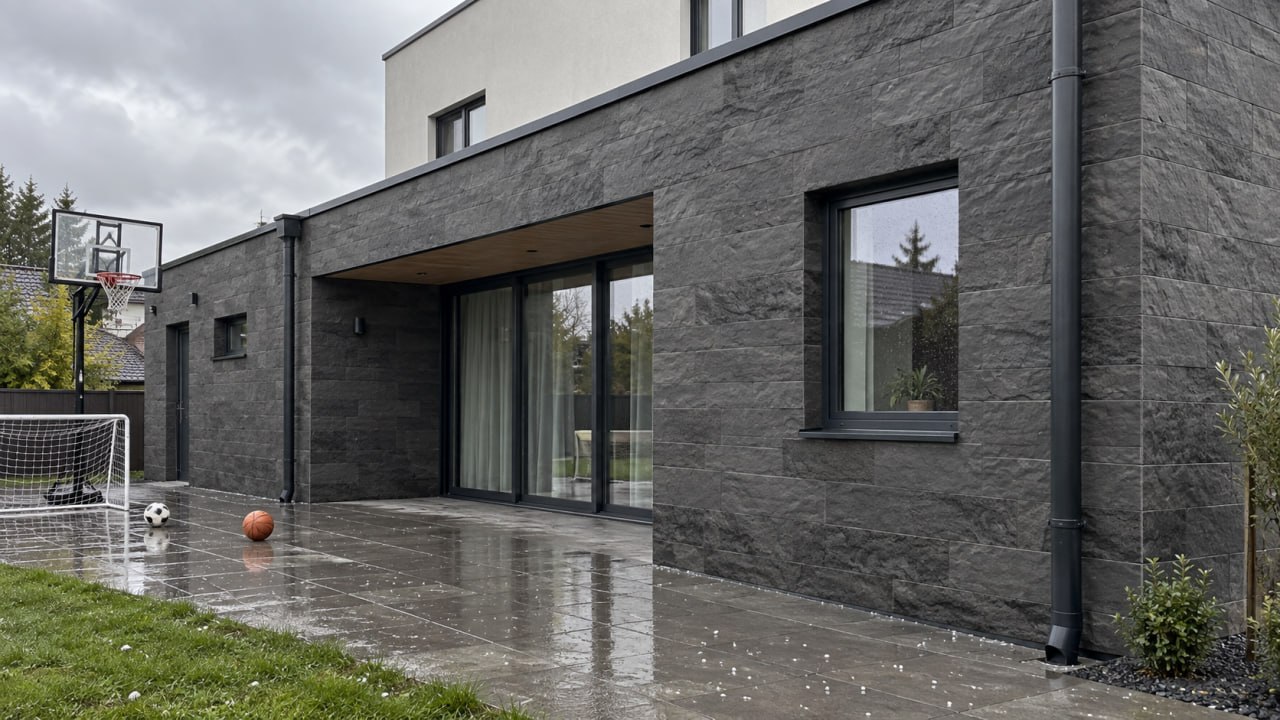
In the yard, the facade is not exposed only to rain, sun and frost. There are areas where the finish takes mechanical stress every day: accidental knocks, hail, balls, bicycles, prams, garden tools, shoes, car doors and splashes from the parking space.
That is why, for the active areas of the yard, it is important to choose not just an attractive cladding but a practical material that helps protect the walls and keeps the facade looking neat for many years.
Where the facade gets hit most often
Not all areas of the house are stressed equally. Some sections deteriorate faster than others:
- the plinth around the house;
- the entrance area;
- the walls near the parking space;
- the area next to the garage;
- the sides of the stairs;
- the walls near the terrace;
- the corners of the house;
- the areas next to the gate;
- the walls near the children's play area;
- the facade along the paths.
If these areas are finished with a weak material, the marks of use appear very quickly: chips, scratches, dirty stains, cracks and the loss of the original look.
Why the plinth is the first risk area
The plinth is closest to the ground, so it takes the greatest stress. Dirt, water, snow, sand, small stones, knocks from shoes and garden tools all land on it. Near the parking space, splashes from the wheels and accidental contact are added.
That is why plinth cladding has to be durable, moisture-resistant, practical in colour, easy to clean, resistant to everyday knocks and not too sensitive to dirt.
For the plinth it is better to choose textured stone shades: grey, grey-graphite, grey-beige, sand or a natural stone tone. They mask the marks of use better and do not look dirty after the first rain. The same logic applies to protecting the plinth from moisture.
Hail and weather stress
Hail is a short but aggressive stress. Especially if the facade sits in an open area, without trees, neighbouring buildings or canopies. A weak finish can suffer micro-damage and chips, or lose its neat appearance.
A facade material has to withstand not only ordinary weather but also more intense events: rain, wind, hail, frost, heat, temperature swings, humidity, dust and dirt. The requirements for construction products intended for outdoor use are set at European level by the Construction Products Regulation.
KORDEKO flexible tile (PletaFlex) suits such situations because it combines the look of stone, low weight and practicality on the facade, plinth, corners, entrance area and other heavily used surfaces.
Balls, bicycles and everyday life
In reality, the yard does not stay empty. Children play with a ball, someone leans a bicycle against the wall, and boxes, ladders, tools and garden accessories are carried through the entrance area. All of this comes into regular contact with the facade.
If the finish is too fragile, every knock can leave a mark. Damage is especially visible on uniform, smooth surfaces. A textured cladding is more practical: it masks small marks better and gives the facade a visually more robust look.
Parking next to the house: a stress of its own
If the car is parked close to the facade, the wall area near the parking space has to be particularly durable. This is where splashes of dirt, sand and small stones, tyre marks, accidental contact with the car door, knocks from bags, boxes and tools, and dirt from the road all appear.
For such areas it is better to avoid very light, delicate finishes. It is more practical to finish the lower part of the wall with a stone look, or to highlight the plinth area with a more durable material.
The entrance area: good looks plus durability
The entrance to the house has to look neat every day. Yet this is exactly where the finish is stressed most often: shoes, bags, deliveries, prams, snow, water, cleaning, knocks to corners and walls.
A good finish for the entrance area has to clean easily, resist moisture, withstand accidental contact, keep its colour, not crack and go with the main facade.
If the entrance area is done in the same texture as the plinth or as an accent area of the facade, the house gains a more unified and more valuable look.
Why the substrate matters as much as the material's durability
Even an impact-resistant finish will not perform correctly if the substrate is weak. If the render is detaching, the wall is dusty, or there are voids or cracks, the final layer cannot compensate for these problems.
Before installation, check the strength of the substrate, the absence of detachments, the flatness of the surface, the correct primer, an adhesive suited to facades and the protection against water in the lower areas. Only after the substrate is prepared correctly can a stable result be achieved, which is why flexible tile installation always starts with the substrate.
Insulation and the protection of active areas
When facade insulation is carried out, the risk areas have to be planned in advance. The plinth, the entrance, the corners, the stairs, the parking space and the terrace need reinforced details, correct reinforcement and a practical finish.
It is particularly important that no vulnerable areas are left on the external corners, near the sills, in the lower part of the wall, at the transition to the plinth, next to the stairs, under downpipes and near the garage and the parking space.
In the areas where the facade is exposed most often to knocks and moisture, the finish has to play not just a decorative role but a protective one.
How to choose the colour for an active area of the yard
For heavily used areas it is better to choose practical shades: medium grey, grey-beige, sandy stone, warm graphite, brown-grey or a natural stone colour.
Very white finishes quickly highlight dirt, shoe marks and water run-off. Very dark shades can accentuate dust and small scratches. Medium, textured tones usually look neater in daily use and keep their colour over time.
A mini-checklist for the active area of the yard
Before choosing the cladding, it is worth answering a few questions:
- Is there a parking space or a garage nearby?
- Do children play next to the house?
- Are the walls frequently touched by bicycles, prams or tools?
- How dirty does the plinth get after rain?
- Are there corners that get knocked frequently?
- Can the surface be cleaned easily?
- Are the walls protected against water and splashes?
- Is the finish suitable for outdoor use?
This approach helps choose the material not just on looks, but according to the real conditions of use.
Conclusion
The active areas of the yard need a finish that withstands not only the weather but also everyday stress: knocks, hail, balls, bicycles, parking, dirt and frequent cleaning.
KORDEKO flexible tile helps create a facade that is practical and attractive at the same time: it protects the plinth, the entrance area, the corners and the walls near the parking space, while keeping the look of stone and the unified style of the house.
Frequently asked questions
Which areas of the facade wear fastest?
Which colour is most practical for the plinth and the entrance area?
Is a durable material enough if the wall is old?
Need advice on your facade?
- ·Get a free consultation for your project
- ·Find out which material suits your facade
- ·We'll answer all your questions and help you choose